



Why Laser PoC Must Be Designed for Scale from the Start
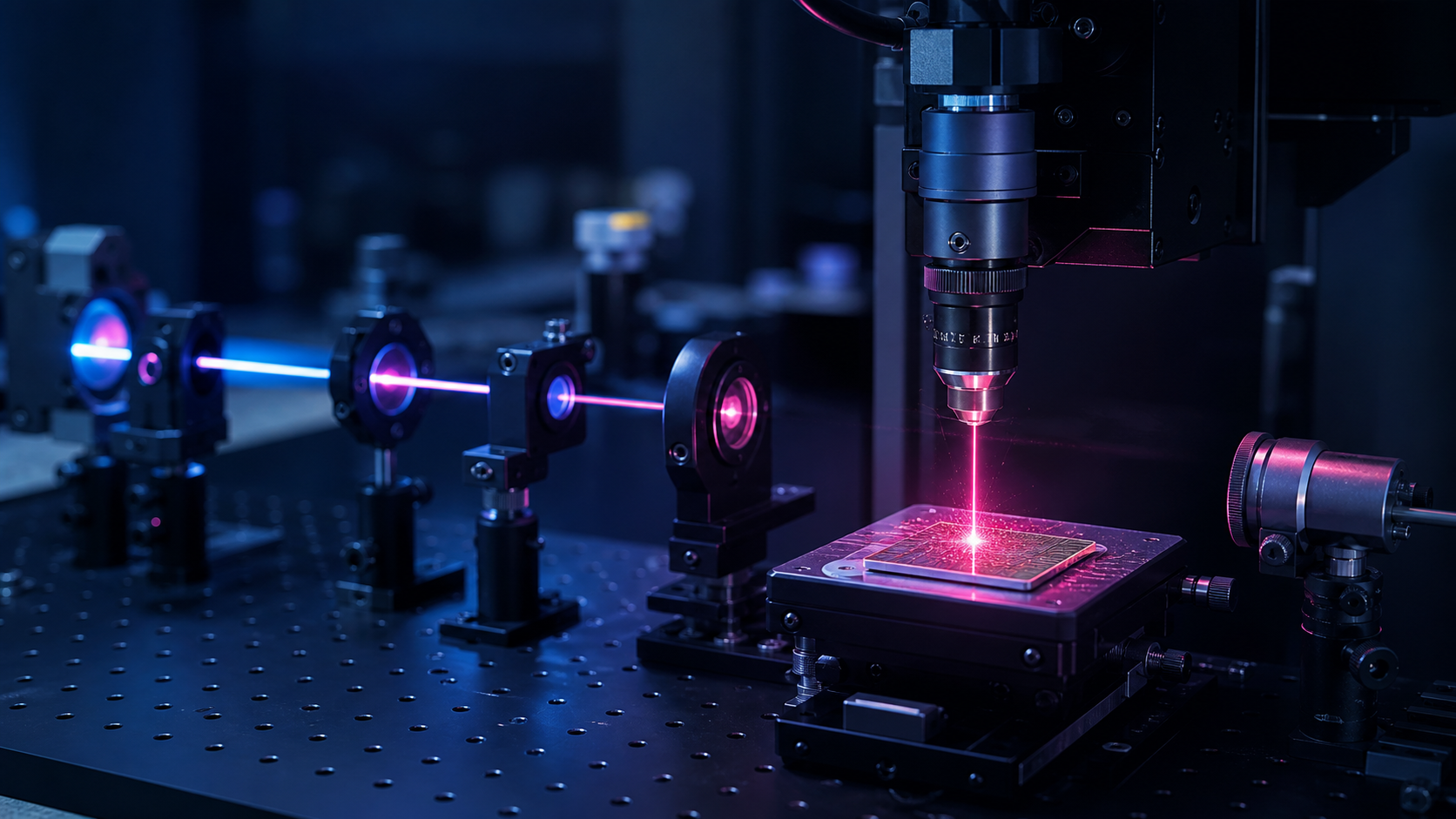
In laser processing, even when excellent results are obtained at the trial stage, quality and takt time can become unstable once the process moves to the production line.
A condition that produces clean results once in a lab environment and a process that reproducibly delivers those results while absorbing variation in materials and equipment state are different things.
Therefore, what laser PoC must confirm is not just “can it be processed.” How to evaluate the required quality, what condition range can be stably reproduced, and whether the required takt time including transport and positioning can be achieved — all of these must be organized from the trial stage.
A Successful PoC Is Not Yet a Production Process
In laser processing PoC, the first check is whether the target material can be processed. However, when production is the premise, that confirmation alone is insufficient.
In production processes, material lot differences, workpiece positioning variation, changes in equipment state, and temperature environment fluctuations occur. If the processing conditions from the PoC are fragile to these variations, even a successful trial will not yield stable quality in production.
Furthermore, if PoC proceeds by looking only at processing results, alignment with takt time, transport, inspection methods, and safety design may not be achievable later. In that case, conditions must be re-established at the production equipment deployment stage, increasing development time and cost.
Design a Process Window, Not a Single Point
What production requires is not a single successful condition but a range of conditions that can be processed stably.
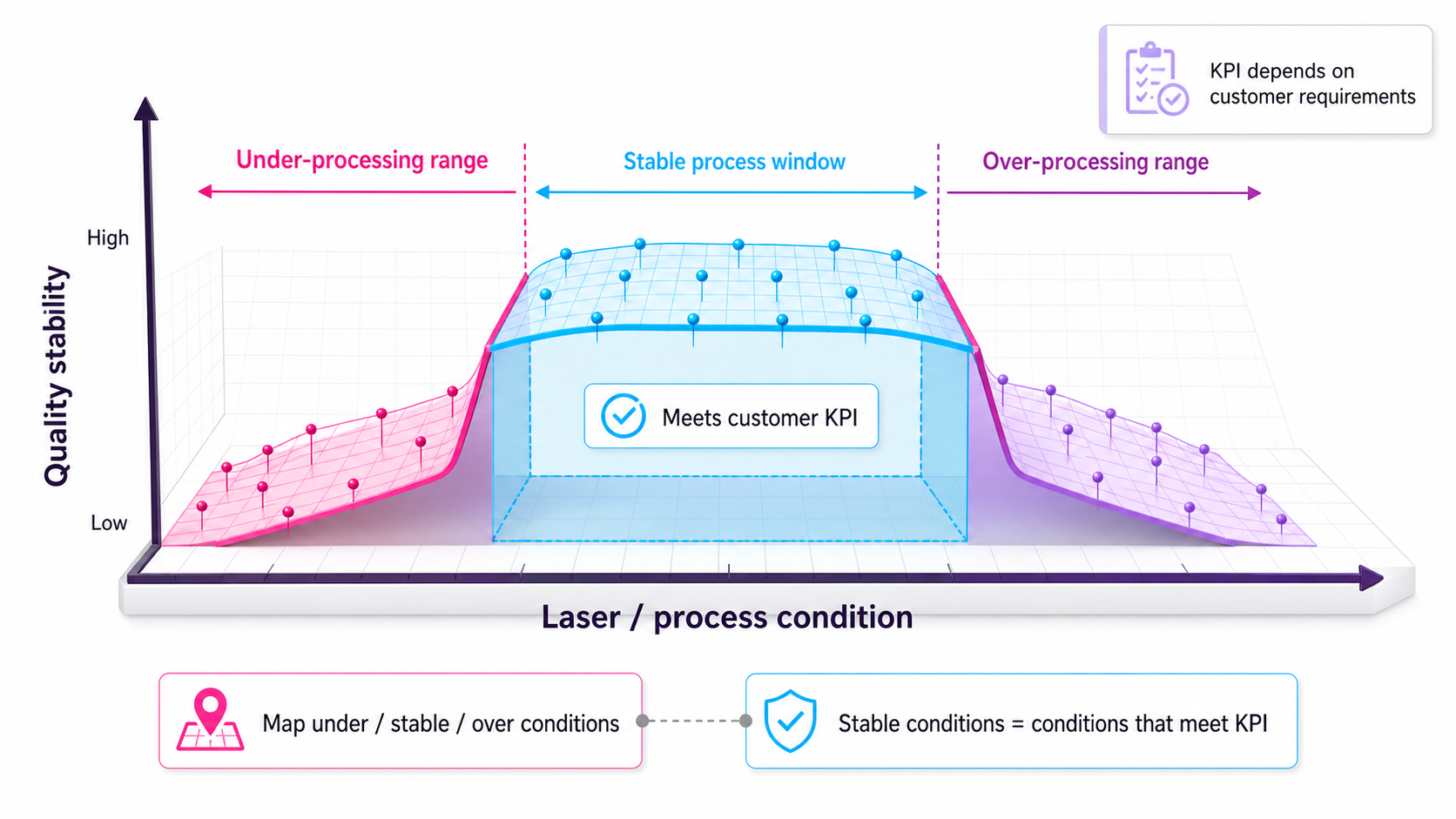
A process window is the condition range within which processing can be performed stably while meeting quality standards. Even when conditions such as laser output, scan speed, focal position, and number of irradiations change slightly, the quality target must still be met.
To achieve this, first “what constitutes a pass” must be decided. Whether only appearance is checked, dimensional accuracy, impact on the base material, or even adhesion and conductivity in subsequent processes determines what must be evaluated in the PoC.
Next, the conditions for under-processing, stable processing, and over-processing are separated. By understanding this range, even with some variation in materials or equipment, the process can be designed to stay within quality standards.
Furthermore, in production, the process must work not just for the processing time alone but including transport, positioning, inspection, and maintenance. Considering these at the PoC stage reduces rework at production deployment.
Design From Test Processing Through Production and Maintenance as a Single Process
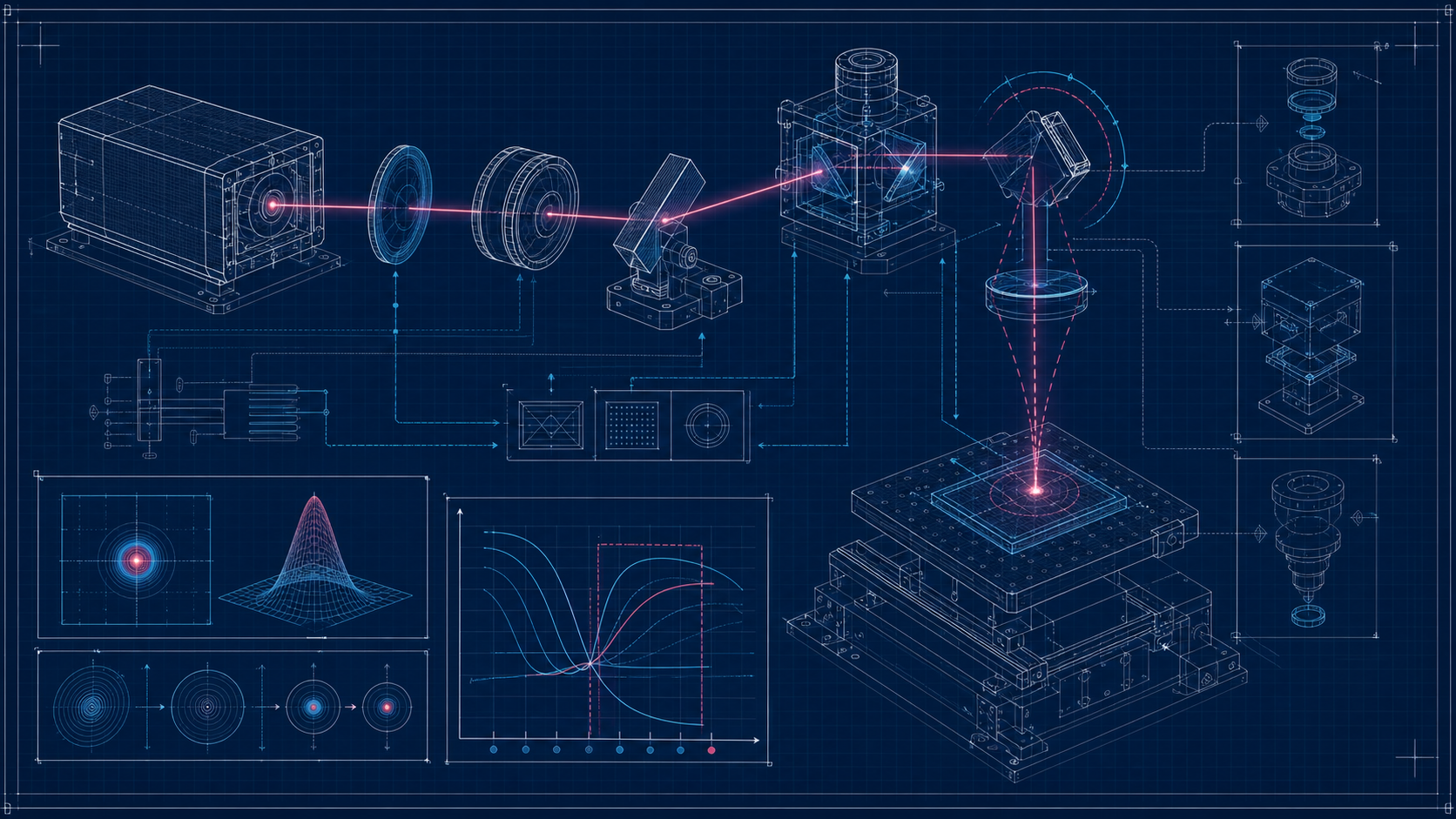
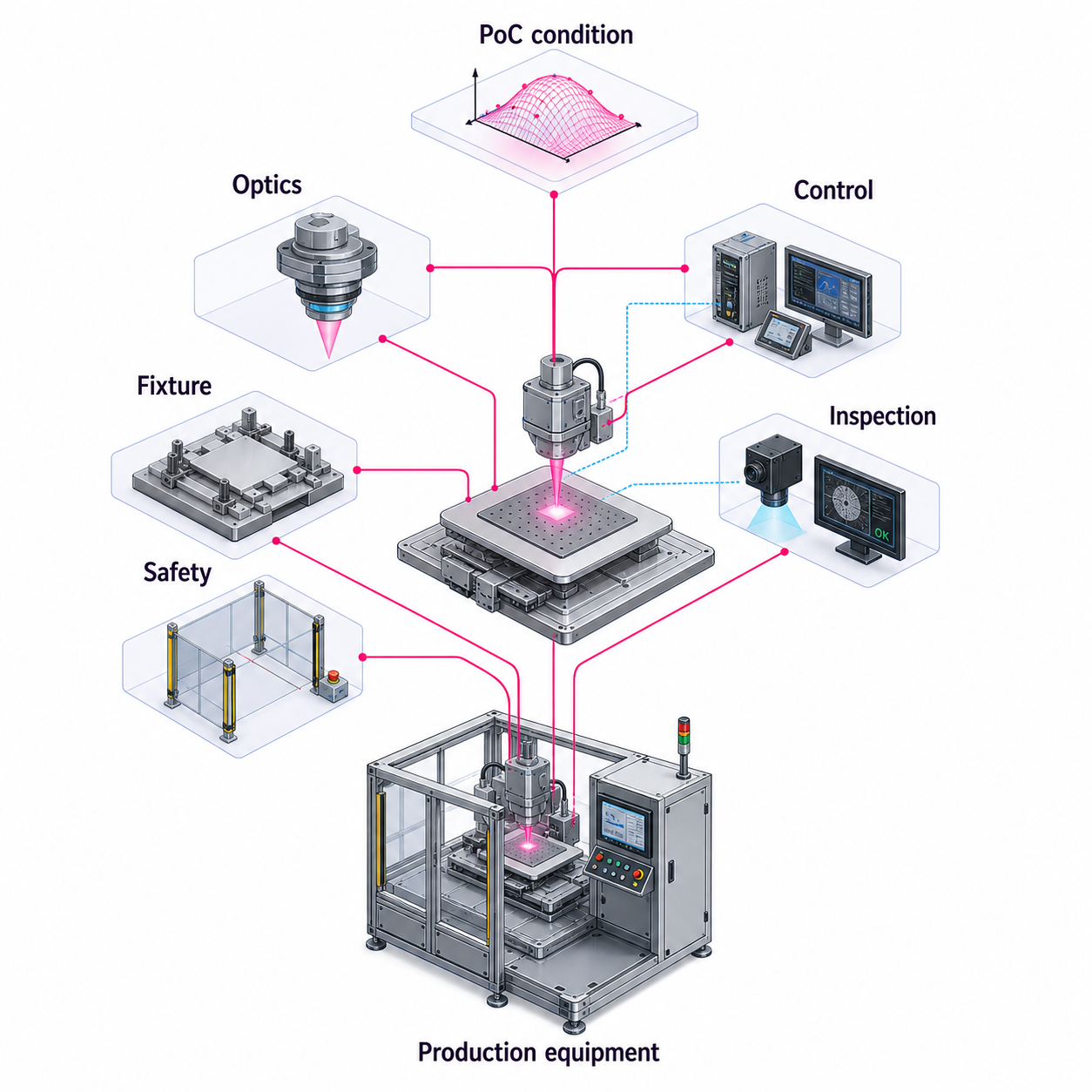
If the conditions used in the PoC are not connected to the optics, control, fixtures, and safety design of the production equipment, re-verification will be required at deployment.
In particular, in laser processing, oscillator and optics selection, processing head configuration, workpiece fixation methods, and inspection methods affect processing quality. Trial stage conditions cannot necessarily be transferred directly to production equipment.
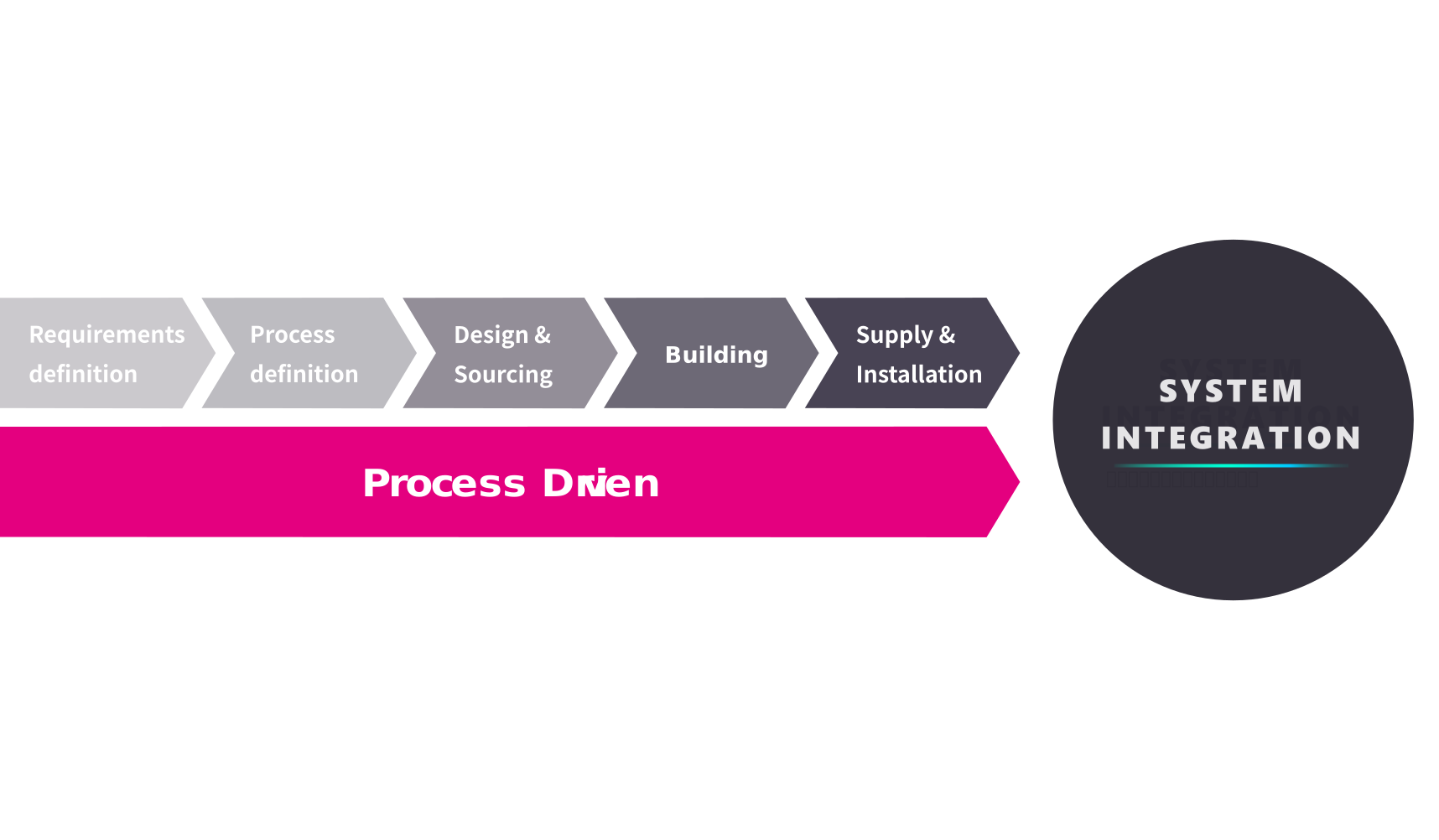
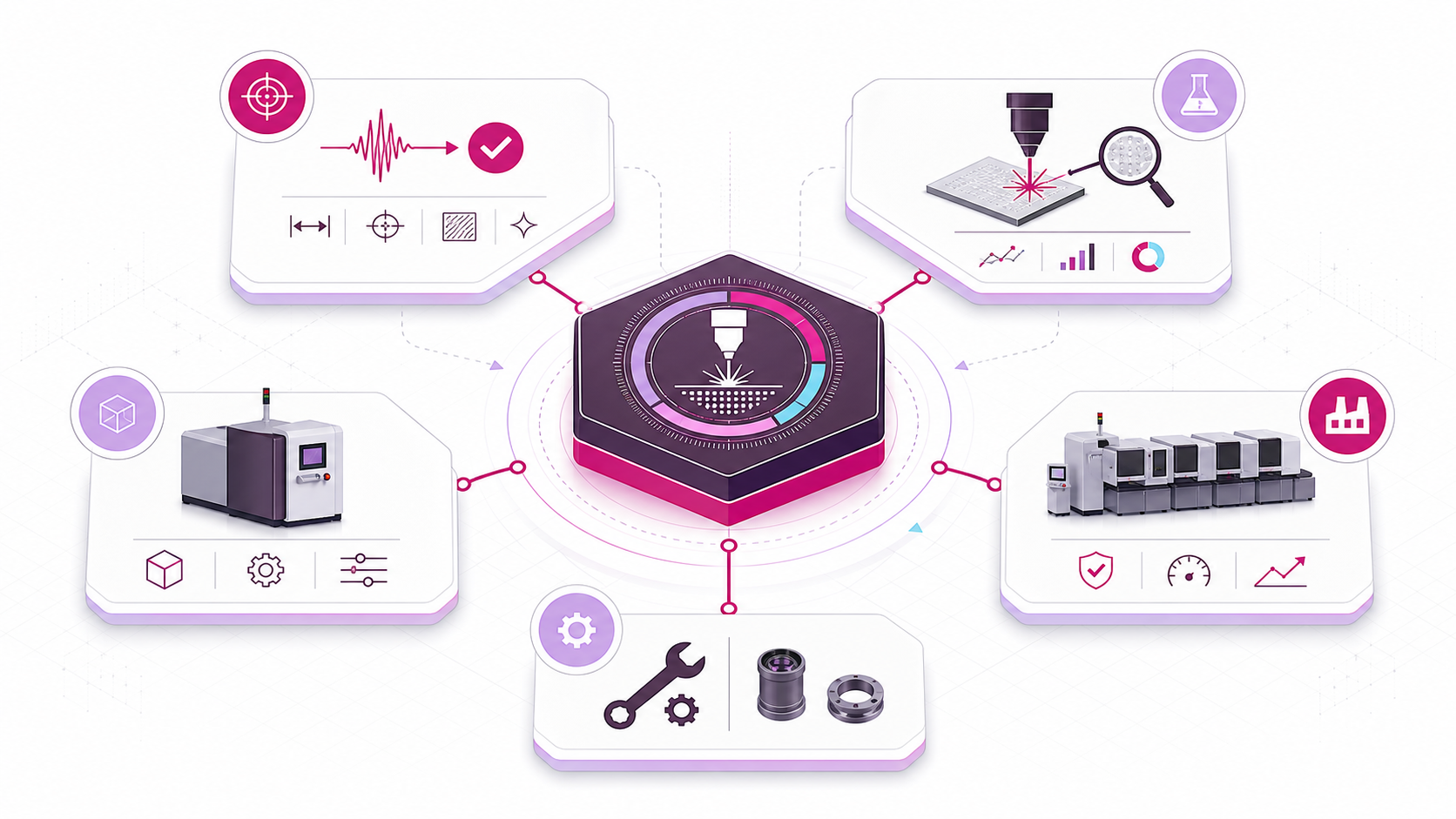
This is precisely why laser PoC must be designed for production from the start. By organizing the conditions obtained in test processing as a process connected to prototyping, production deployment, and maintenance, rework on the path to production can be reduced.
Quantec works backward from the required processing result and designs test processing, prototyping, production deployment, and maintenance as a single process.