



Why Chemical-Free Patterning Matters in Manufacturing

In manufacturing processes such as touch panels, photolithography is used to form fine patterns. While photolithography is well-suited for high-precision processing, it involves multiple steps — development, etching, and cleaning — requiring management of chemical waste and wastewater.
If some of these steps can be replaced by direct laser patterning, it may be possible to reduce the steps that use chemicals and ease the burden of waste treatment and wastewater management.
However, introducing laser technology does not automatically make a process viable. What matters is designing a process that works as a production process, suited to the target material and required quality.
The Background Driving Chemical-Free Patterning: The Waste Load of Photolithography
Conventional photolithography involves chemical-based steps to form patterns. For example, the etching step to remove unwanted film generates metal-containing waste, and the development step requires processing of developer. Furthermore, cleaning is required before and after each step, making wastewater management unavoidable.
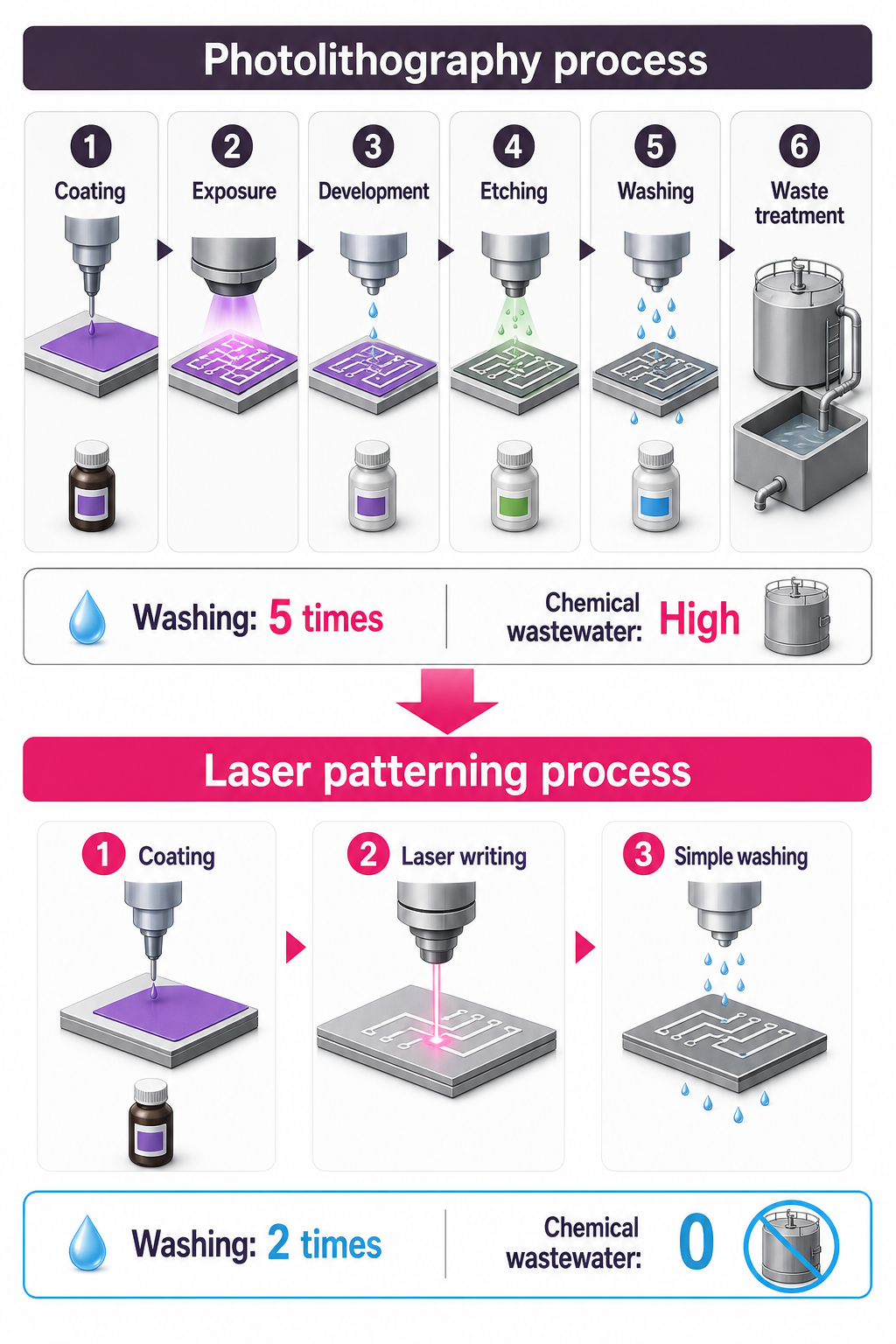
In manufacturing processes that form multiple layers, such as touch panels, these steps are repeated. As a result, the burden of waste treatment, wastewater management, chemical handling, and cleaning equipment grows significantly.
Laser patterning is a processing method that directly irradiates the target material with laser to remove unwanted portions. When process design succeeds, it can reduce chemical steps such as development and etching, and suppress the generation of chemical waste.
In a Quantec study of a touch panel manufacturing process, a configuration was designed in which laser patterning eliminated chemical waste from the targeted steps and reduced the number of washing cycles from five to two.
Waste Reduction Is Also Related to Factory Startup and Operating Conditions
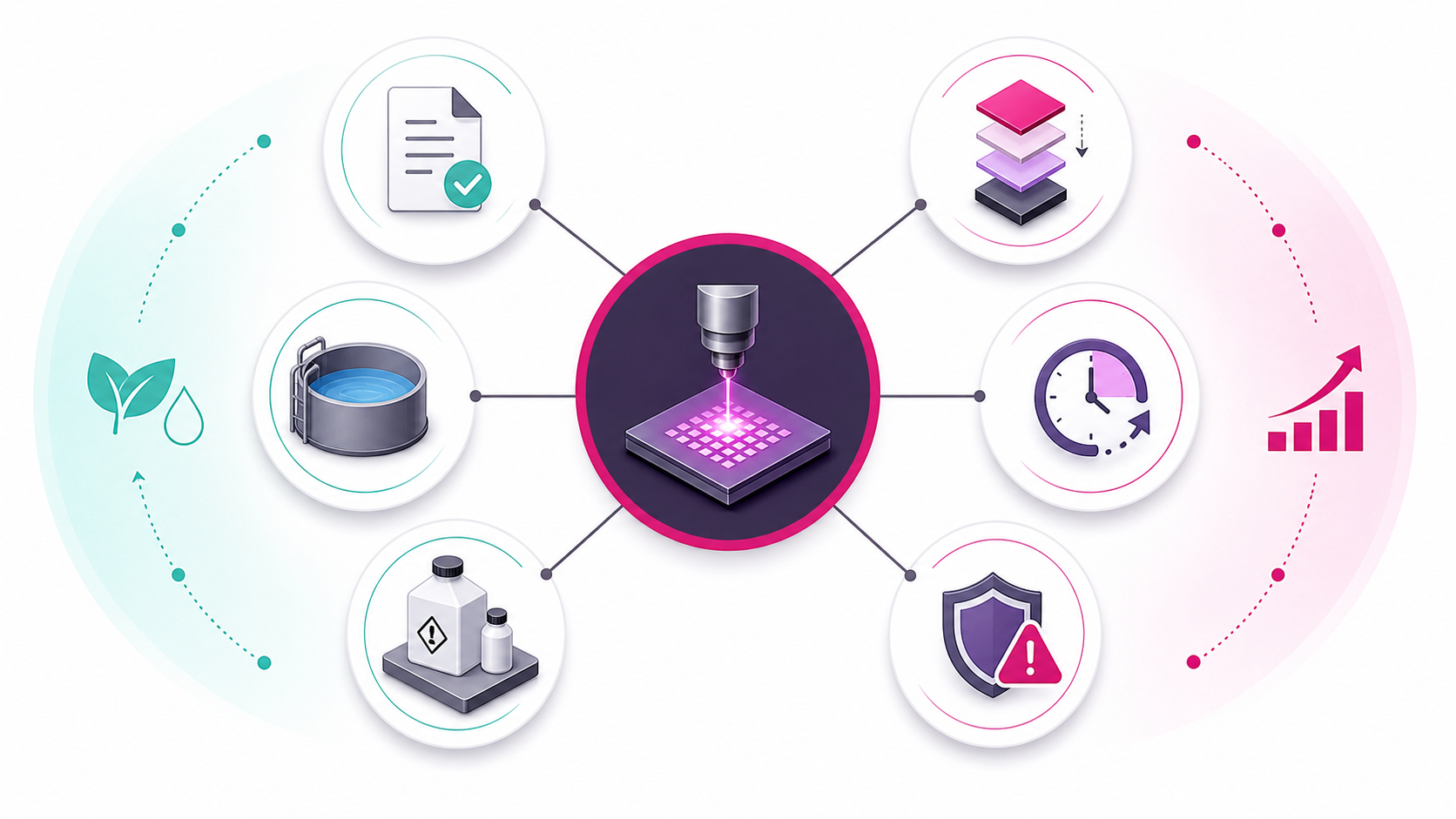
The value of chemical-free processing is not limited to reducing waste volume.
Factories generating significant chemical waste and wastewater require wastewater treatment facilities and chemical management systems. Depending on the region, the level of environmental impact can affect factory establishment permits and operating conditions.
Therefore, chemical-free patterning is not simply an environmental response. It is also a theme related to manufacturing economics — how much wastewater treatment infrastructure can be simplified, how much the burden of chemical management can be reduced, and how much process count can be held down.
Environmental responses in manufacturing do not spread on principle alone. To be adopted in production environments, process design is needed that not only reduces environmental impact but also makes factory startup and operation realistic.
Replacing With Laser Cannot Be Achieved by Equipment Alone
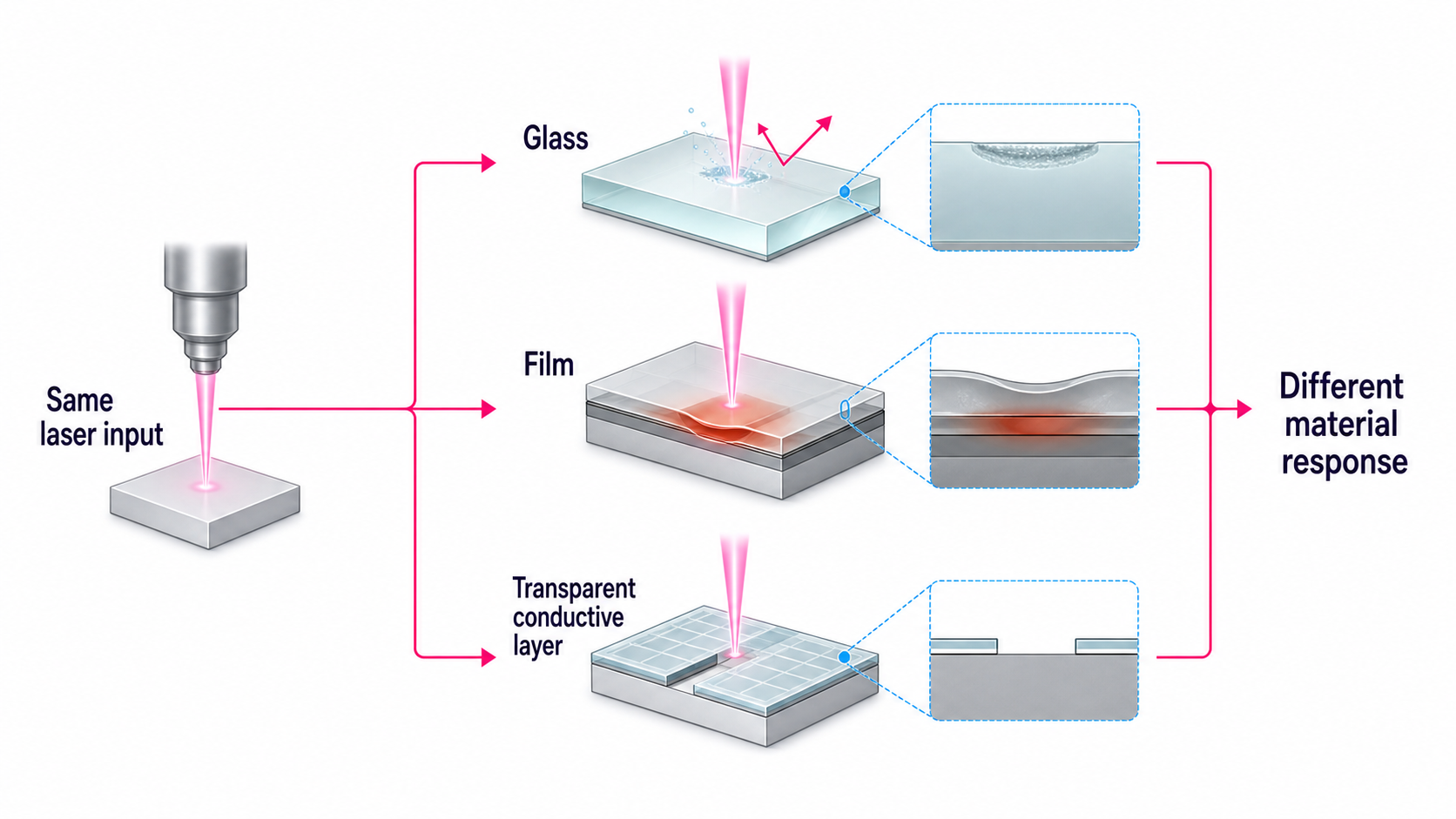
On the other hand, using laser does not mean existing processes can be replaced as-is.
Even for the same type of patterning, material response varies depending on whether the target is glass, film, or transparent conductive film. As film thickness and layer structure change, the required laser conditions also change.
Furthermore, in production processes, being able to process cleanly is not sufficient. It must be verified whether large areas can be processed stably, whether quality is disturbed at processing seams, whether burning or discoloration from thermal influence occurs, and whether the speed required for production can be achieved.
In other words, whether laser patterning can be adopted cannot be determined by equipment output or specifications alone. It requires confirming how materials respond, and designing a process that stabilizes that response in production.
Pre-Verification Working Backward From Material and Production Requirements Is Critical
When evaluating chemical-free patterning, it is first necessary to confirm whether laser processing can work on the target material. Then, taking into account the required processing quality, processing area, production speed, and connection conditions with subsequent processes, a condition range that works as a production process must be designed.
Introducing equipment without this verification can lead to problems such as acceptable processing quality but mismatched takt time, unstable quality over large areas, or defects in subsequent processes.
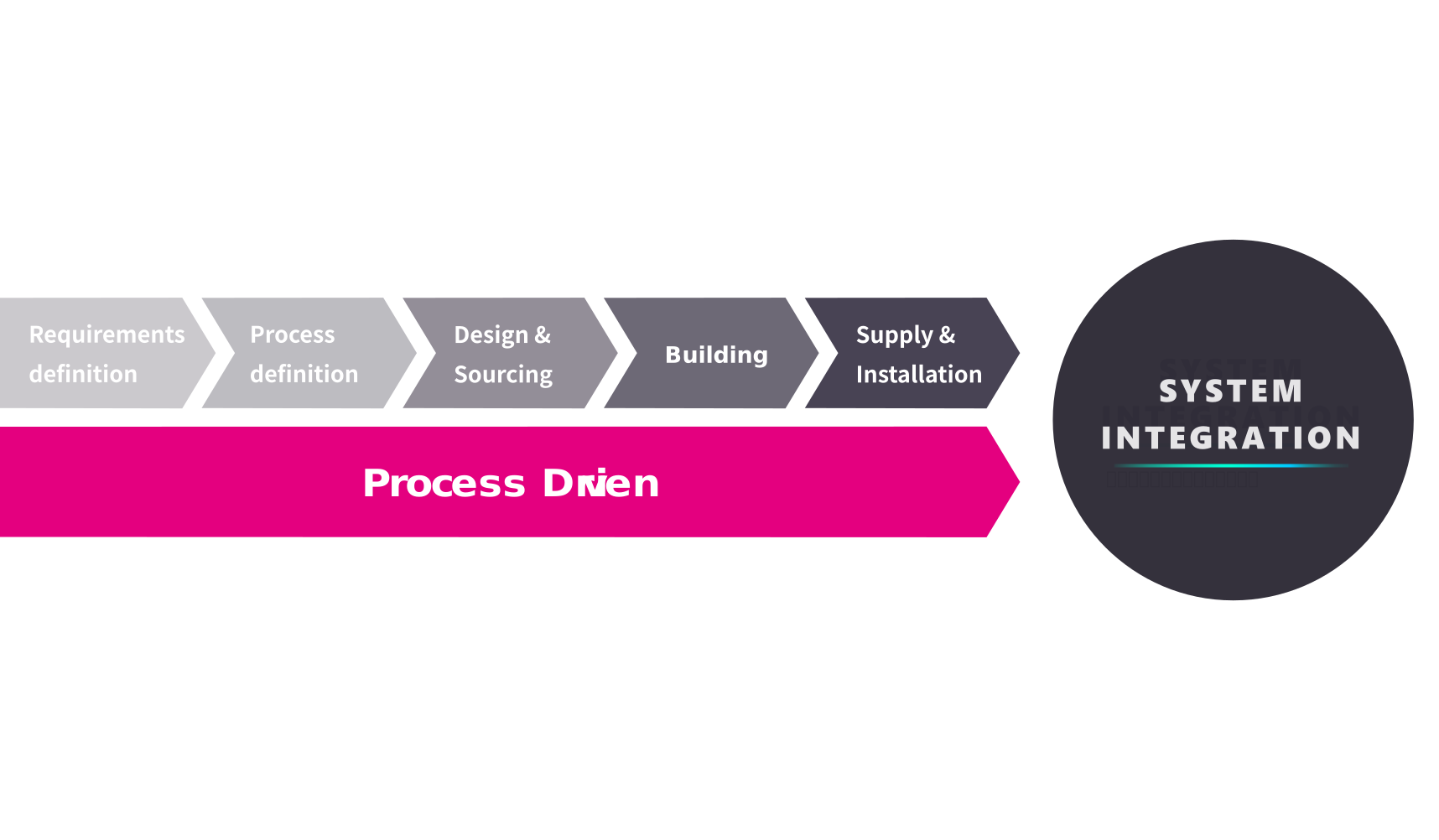
Quantec offers consultation from laser condition verification for target materials through process design for production deployment.
Consult on chemical-free patterning pre-verification
Explore the PICTURA large-area 3D laser marker and read Economically Sustainable Manufacturing.